
Why an agent needs an action layer
The real question is not whether an agent can pay. It is whether you would let one manage your money.

AI agents can pay for things now. Visa and Mastercard are setting standards for it, and Coinbase, Stripe and AWS shipped ways for an agent to pay in USDC. Give an agent a wallet and it can hold money and send it. That much is real.
But paying is the easy part.
Sending money is not the same as managing it. The things people actually want come next: earning on a balance, borrowing against it, moving into a market and back out, keeping a portfolio in shape. Every one of those has rules about who can do what, and real risk when it goes wrong. A wallet knows none of that. It just signs whatever you hand it.
So the real question is not whether an agent can pay. It is whether you would let one manage your money. And a wallet, on its own, is not enough to say yes.
What is missing is a layer between the agent and the money. We call it the action layer.
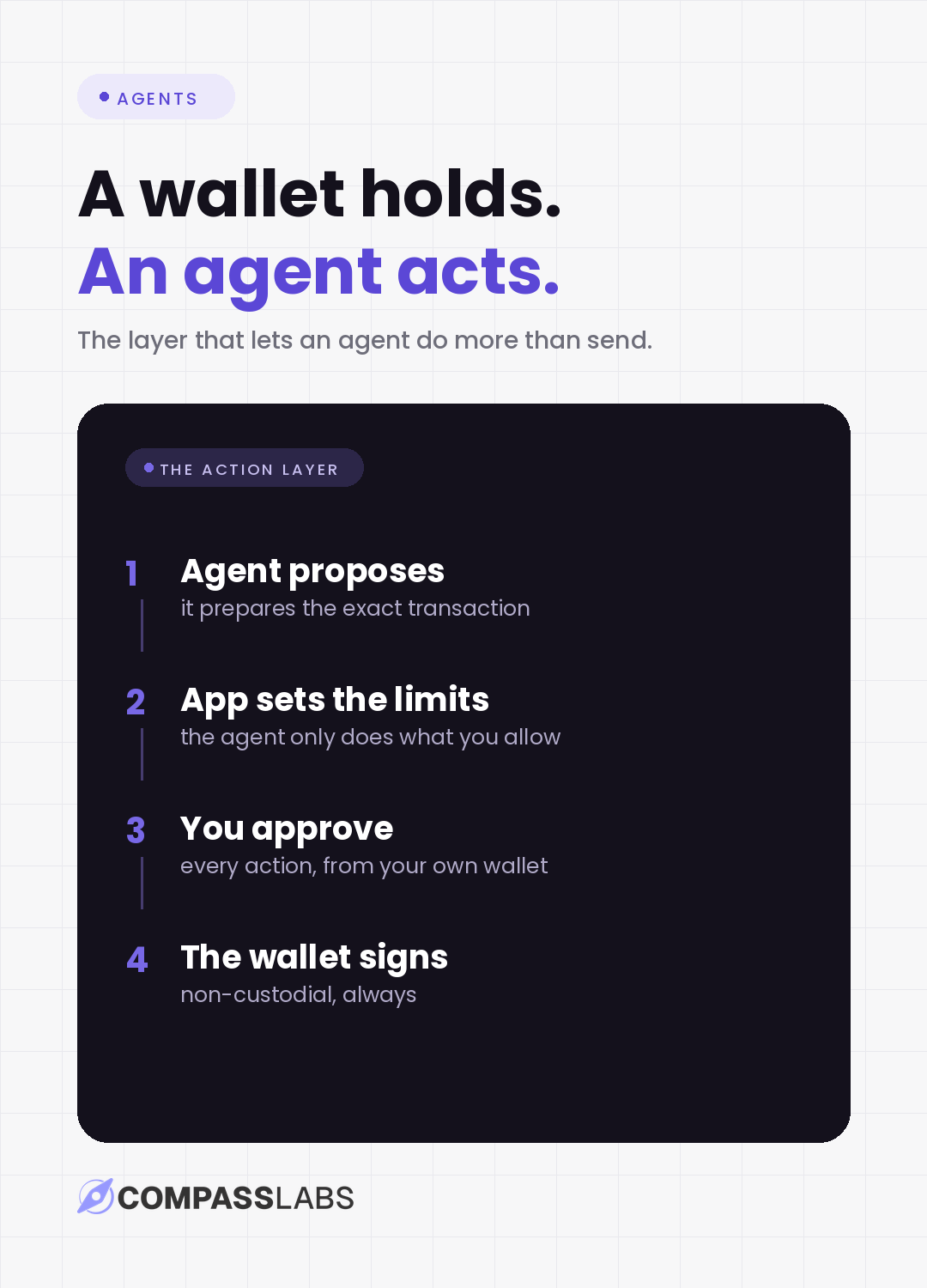
The idea is simple. The agent never touches a protocol on its own. It asks the action layer, which builds the exact move, checks it against the limits the app has set, and hands it to you to approve. The agent suggests. You decide. Nothing happens until you say yes.
That one change is what turns "an agent that can pay" into "an agent you would trust with your savings."
It is also the hard part, which is why most teams stop at the wallet.
Doing the action layer properly is the hard part. It means handling all of this, and keeping it working while everything underneath changes:
- Picking the right venue for a loan
- Folding five steps into one tap
- Covering gas so nobody has to buy ETH first
- Checking who is allowed to hold what
- Putting the risk in front of you, up front
- Surviving every protocol change underneath
That is what we build at Compass. One connection, and an app and its agents get a non-custodial interface to onchain products: earning, borrowing, trading and tokenized assets. Every move comes back as a transaction you approve and sign, and the app sets exactly what its agent can ever touch.
Agents that can pay are already here. Agents you would trust with your money are what comes next. And what gets us there is not a smarter agent. It is the layer underneath it.
Ready to build?
Start at docs.compasslabs.ai, or talk to us at compasslabs.ai.
Sources. Agent payments: Visa, Mastercard and others moved to standardize AI-agent payments in 2026 (coverage); Coinbase, Stripe and AWS shipped USDC payments for agents via Amazon Bedrock AgentCore Payments, generally available August 2026 (The Block, Coinbase).