
Our Philosophy
The goal of Compass is to let any platform offer DeFi products to their users — yield, credit, trading — without building blockchain infrastructure themselves. But to do that responsibly, we had to solve a problem that most DeFi infrastructure ignores: fund isolation.
When a platform offers multiple products, each product carries different risk. A user earning yield on stablecoins has a very different risk profile from a user borrowing against ETH. If those funds sit in the same wallet, one liquidation event can affect everything.
For Compass to work for real platforms serving real users, we needed non-negotiable properties:
- Every user's funds are isolated per product
- No product can accidentally affect another product's funds — but users can move money between accounts when they want to (like moving yield-bearing assets into a Credit account to borrow against them)
- Compass infrastructure never touches user funds — users can always withdraw their money directly, even in a worst-case scenario
- Everything is verifiable on-chain
This article focuses on the account layer. How do product accounts work in Compass, and why did we build them this way?
An Overview
Every Compass user gets a separate account for each product they use. One for Earn. One for Credit. If we add Trading tomorrow, that's another one.
These are not shared pools. They are individual accounts, one per user per product, deployed on-chain and controlled exclusively by the user's own wallet.
The user's existing wallet — whatever they already use — is the only one that can move funds. Compass infrastructure has no control over user funds.
The User Stays in Control
There is no account-specific key, no new seed phrase, no additional authentication layer to be managed. When a user deposits into Earn or borrows from Credit, they sign the transaction with their own wallet. Compass constructs the transaction, but the user signs and broadcasts it.
If we disappeared tomorrow, every user's funds would still be accessible through their own wallet. The accounts live on a public blockchain — they don't depend on us to exist.
Why Separate Accounts Per Product
Products carry different risk. Earning yield on stablecoins is relatively low risk. Borrowing against volatile collateral is higher risk — if the collateral drops, the position can be liquidated.
If both products shared an account, a liquidation on a credit position could drain funds that were supposed to be safely earning yield. Separate accounts prevent this by default.
When a user deliberately wants to use their yield-bearing assets as collateral for a loan, they can move funds between accounts in a single step. It's a choice, not an accident.
This also unlocks capabilities that matter for real products:
- Transaction bundling: Multiple actions — like approving and depositing — can happen in a single transaction. The user signs once.
- Gas sponsorship: Platforms can cover transaction fees for their users so they never need to hold ETH just to use the product.
- Clean accounting: Every product has its own on-chain history. Platforms can track, report, and audit each product independently.
How It All Fits Together
A platform integrating Compass calls our API. When their user wants to start earning yield:
- The platform requests an Earn account for the user
- Compass returns a transaction that creates the account, with the user as the sole owner
- The user signs from their own wallet
- The Earn account is live — the user deposits, and funds flow directly into on-chain lending markets
When that same user wants to borrow against their crypto:
- The platform requests a Credit account
- A separate account is created — same owner, different account
- The user deposits collateral and borrows — completely isolated from their Earn position
The platform sees both accounts through the Compass API, including real-time balances, positions, health factors, earnings, and transaction history for every account. The user interacts with both through the platform's interface. But on-chain, they are separate accounts with separate funds and separate risk profiles.
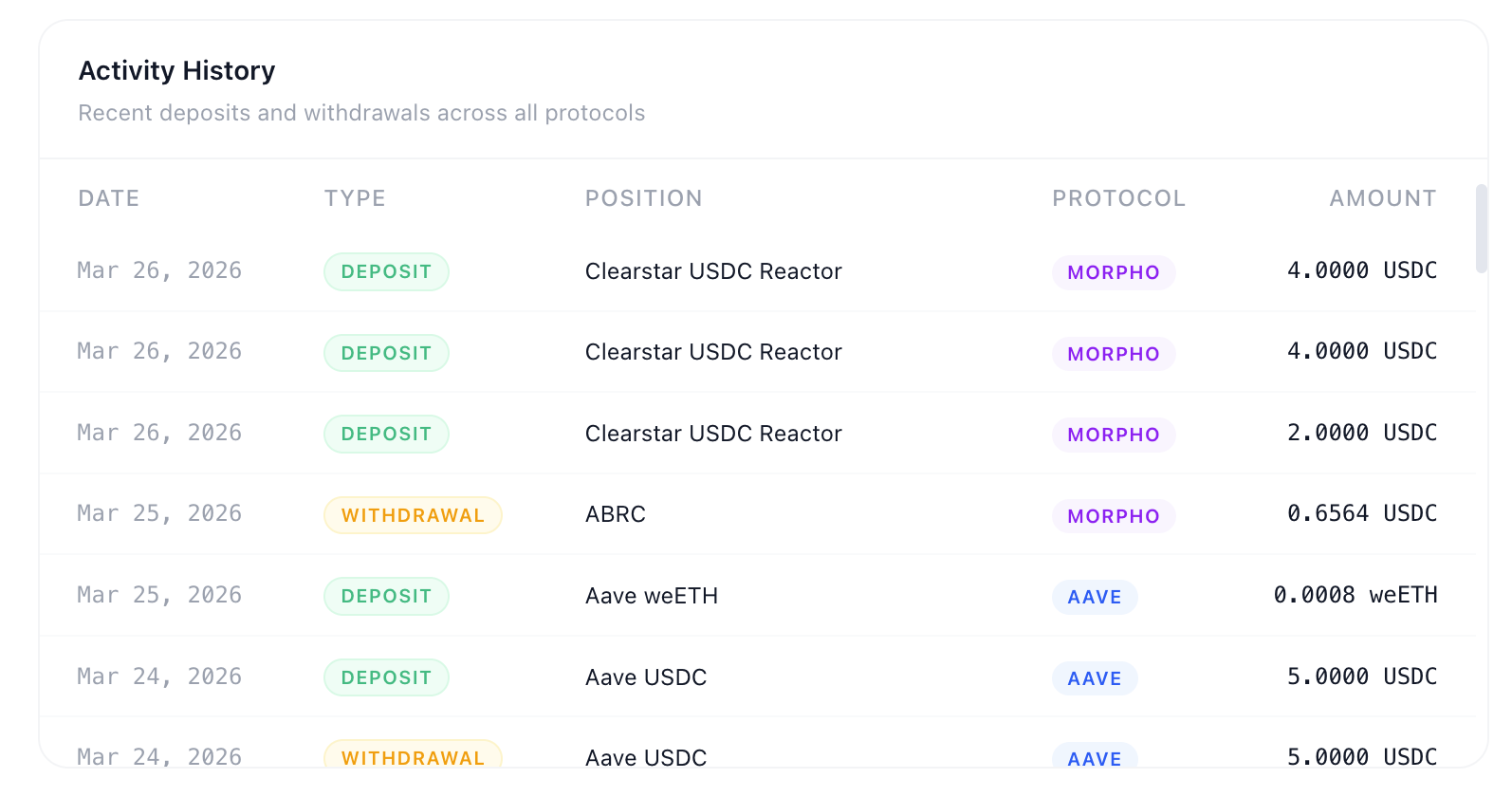
Every transaction is signed by the user. Every position is verifiable on-chain. Compass constructs, but never controls.
Compass does not control DeFi protocols or smart contracts. Using DeFi protocols involves risk, including potential loss of funds. This is not investment advice.